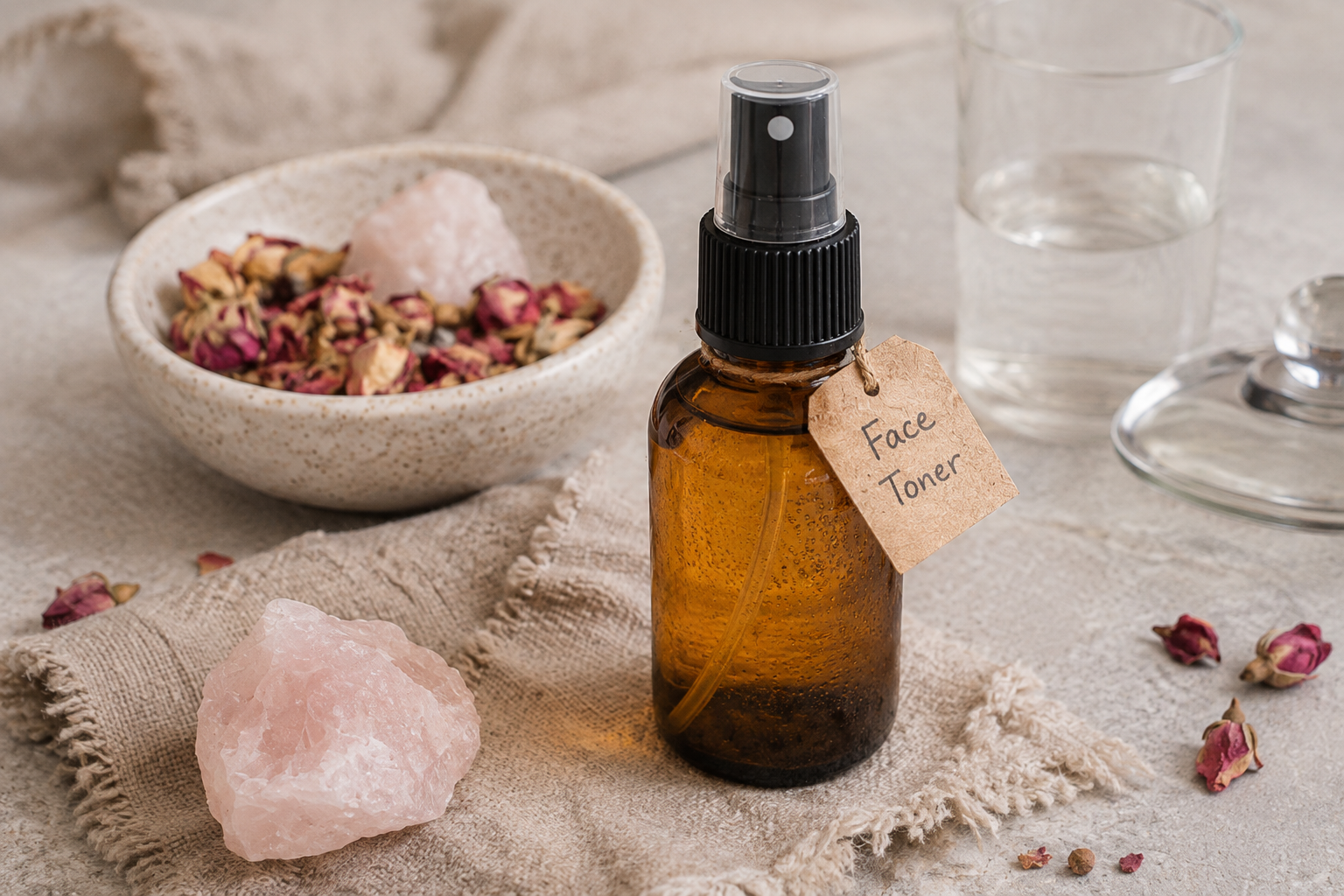
I love homemade skincare recipes that don’t require a cupboard full of specialty ingredients. Sometimes the simplest formulas are the ones we actually continue making.
This easy homemade face toner starts with just distilled water, alcohol-free witch hazel and a little glycerin. If you have rose water or another floral hydrosol on hand, you can use it as an optional botanical addition—but you don’t need it to make the recipe.
And while face toner may sound like a modern skincare product, fragrant botanical waters have a much longer beauty history. Rose water, lavender water and other distilled floral waters were already appearing in beauty preparations during Jane Austen’s lifetime.
So after the simple recipe, we’ll take a little trip back to the dressing tables of the late 18th and early 19th centuries.
Why Use a Face Toner?
A toner is a simple step between cleansing and the rest of your skincare routine. Depending on its ingredients, it can refresh the skin and add a light layer of hydration before applying serum, face oil or moisturizer.
For homemade toner, I prefer alcohol-free witch hazel, which avoids the drying feel associated with high-alcohol formulas.
Glycerin is included in a small amount as a humectant, helping attract and hold moisture at the skin’s surface.
And then there is my favourite optional addition: floral water.
Simple Homemade Face Toner
This is the version to start with if you’re new to making skincare. It requires only a few ingredients and takes minutes to prepare.
Ingredients — 100 mL
- 67 mL distilled water (optional: replace some or all with rose water or another skin-safe hydrosol)
- 30 mL alcohol-free witch hazel
- 2 mL vegetable glycerin
- 1 mL Geogard ECT, optional*
Directions
- Pour the distilled water and witch hazel into a clean, sanitized measuring cup or beaker.
- Add the vegetable glycerin and mix well.
- If using Geogard ECT, add it and stir thoroughly.
- Transfer the toner to a clean 100 mL bottle and label it with the date.
How to Use
After cleansing, apply a small amount to a reusable cotton pad and gently sweep it over the face and neck, avoiding the immediate eye area.
You can also put your toner into a fine-mist bottle and lightly mist clean skin.
Follow with your usual serum, face oil or moisturizer.
Optional: Make It a Floral Toner
This is where you can have a little fun with the basic recipe.
Replace some or all of the distilled water with a skin-safe floral water or hydrosol. I particularly love rose water, especially when I have homemade rose water available.
Other possibilities include lavender, chamomile or orange blossom hydrosol.
Just remember that botanical doesn’t mean self-preserving. Once water is part of a homemade cosmetic, proper preservation and clean preparation become important.
What If I Don’t Want to Use a Preservative?
If you plan to keep a water-based homemade toner, a suitable broad-spectrum cosmetic preservative is the safest option.
If you prefer to make your toner without one, make a very small batch, keep it refrigerated in a clean container and use it within a few days. Discard it immediately if you notice any change in smell, appearance or texture.
A Little Beauty History: Floral Waters in Jane Austen’s Time
Long before bottles labelled toner appeared on bathroom shelves, women were already using fragrant botanical waters as part of their toilette.
Jane Austen lived in a world where rose water, lavender water and other distilled botanical waters were familiar beauty and household preparations.
One fascinating glimpse into this world comes from The Toilet of Flora, a beauty manual published in London in 1779, during Jane Austen’s lifetime.
The book contained recipes for perfumes, cosmetics, lotions and scented waters—including preparations for both rose water and lavender water.
And these weren’t simply flowers soaked in water.
Floral waters could be produced through distillation using an alembic, an early type of still. Flowers and liquid were heated, the aromatic vapour travelled through the apparatus, and the condensed fragrant water was collected.
One rose-water preparation described in The Toilet of Flora used Damask roses and even called for the fragrant water to be distilled again with fresh roses to strengthen it.
Beauty took a little more patience in 1779.
From the Alembic to the Modern Bottle
Thankfully, we don’t need to set up an alembic in the kitchen to borrow a little inspiration from the beauty rituals of Jane Austen’s era.
Modern hydrosols give us a wonderfully convenient version of the same basic idea: aromatic botanical water produced during distillation.
Jane Austen–Inspired Rose & Lavender Facial Water
This isn’t a recipe attributed to Jane Austen herself. Instead, it is a simple modern facial water inspired by the rose and lavender waters used during her lifetime.
Ingredients
- 50 mL rose hydrosol
- 50 mL lavender hydrosol
- Appropriate broad-spectrum cosmetic preservative, optional but recommended for storage*
Directions
Combine the rose and lavender hydrosols in a clean, sanitized bottle.
If preserving the facial water, add your chosen preservative at its manufacturer’s recommended usage rate and ensure it is suitable for your formula and final pH.
Use after cleansing as you would a simple facial mist or toner.
Without a preservative, make only a small quantity, refrigerate it and use it promptly.
Sometimes the simplest beauty rituals are the ones that survive the longest.
My Advanced Face Toner for Mature Skin
The simple toner at the beginning of this post is perfectly suitable when you want something quick and uncomplicated.
But if you’ve been making your own skincare for a while and have a few cosmetic ingredients on hand, you can take it further.
This is closer to the toner I make for myself. I use rose water as the base and add panthenol, allantoin and glycerin, along with a botanical essential-oil blend.
Because essential oils don’t mix properly with water on their own, this version also contains Polysorbate 20 to help disperse them.
Advanced Rose Toner — 150 mL
Base
- 100.5 mL homemade rose water (or rose hydrosol; distilled water can also be used)
- 33 mL alcohol-free witch hazel
- 4.5 mL vegetable glycerin
- ⅜ tsp panthenol powder
- About 3/16 tsp allantoin powder
- 7.5 mL Polysorbate 20
- 1.5 mL Geogard ECT
Essential Oil Blend — 15 Drops
- 3 drops helichrysum
- 3 drops frankincense
- 3 drops lavender
- 1 drop neroli
- 2 drops patchouli
- 1 drop vetiver
- 2 drops rose
Directions
- Combine the rose water, alcohol-free witch hazel and glycerin in a sanitized container.
- Add the panthenol and allantoin and mix thoroughly.
- In a separate small container, combine the essential oils with the Polysorbate 20.
- Add the essential-oil mixture to the water phase and mix well.
- Add the Geogard ECT and stir thoroughly.
- Transfer to a clean, sanitized bottle and label it with the date.
How to Use
Apply after cleansing and before serum, face oil or moisturizer.
Because this version contains several essential oils, patch test it before using it regularly, particularly if your skin is sensitive.
From Floral Waters to Face Toner
The ingredients on our bathroom shelves have changed enormously since Jane Austen’s time, but some beauty traditions have proved remarkably persistent.
What once required flowers, an alembic and a lengthy distillation can now be as simple as opening a bottle of hydrosol.
Whether you make the basic three-ingredient toner, add a splash of rose water, experiment with a historically inspired floral water or make the more advanced version, the idea remains wonderfully simple: a little botanical water between cleansing and the rest of your skincare ritual.