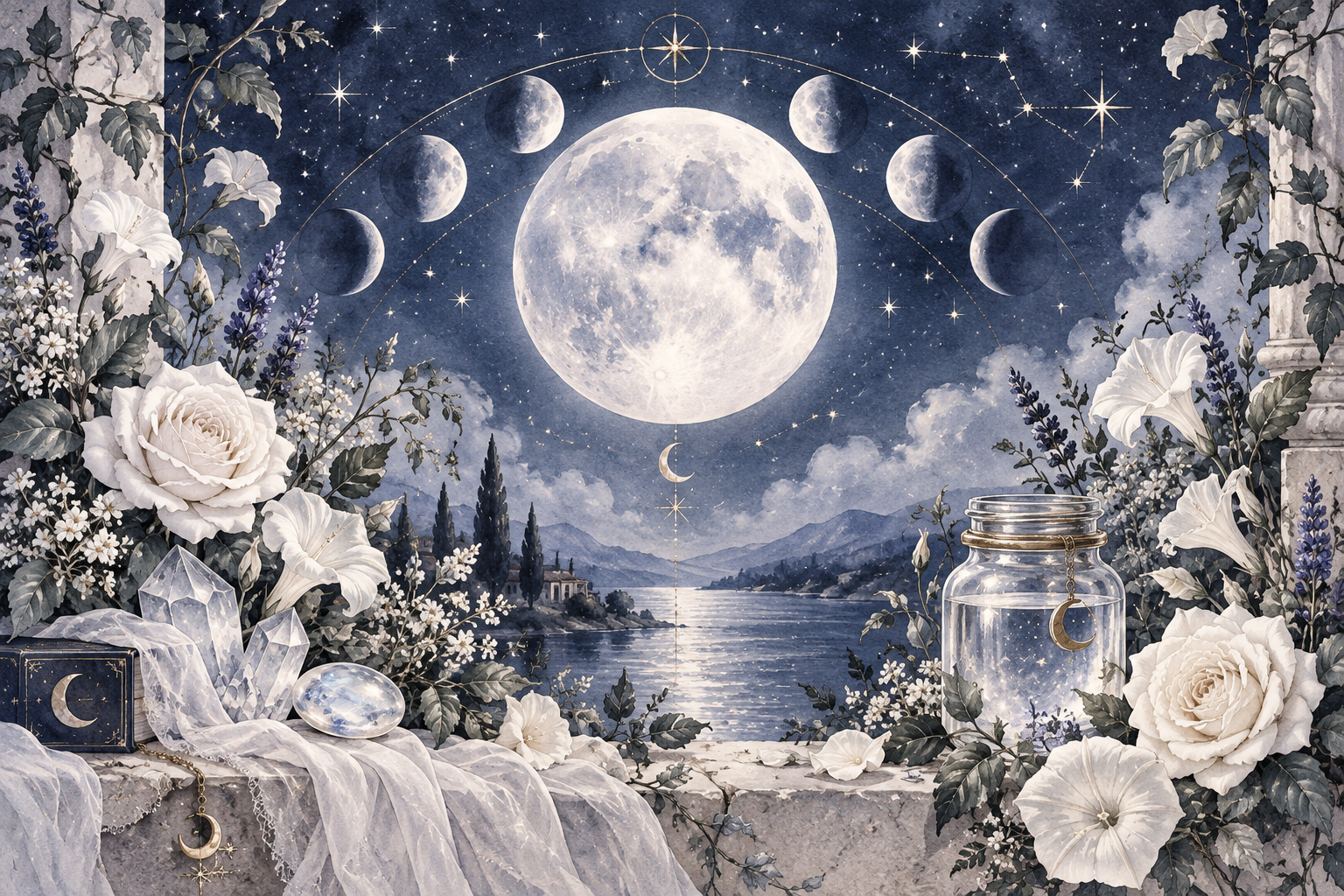
I have always been drawn to the Moon. There is something comforting about looking up and knowing that, no matter how busy or disconnected life becomes, its ancient cycle continues above us—waxing, becoming full, slowly disappearing and beginning again.
For me, living in rhythm with the Moon isn’t about following complicated rules or performing elaborate rituals. It is simply another way of slowing down and becoming more aware of the natural cycles around me—and, in a way, the cycles within myself too.
Some months I pay much more attention to the Moon than others. Sometimes it might be as simple as noticing a beautiful Full Moon from my garden. Other times I might make Moon water, choose a crystal, write down an intention or use the Full Moon as a reminder that there is something I am ready to release.
I don’t feel that any of it has to be perfect to be meaningful.
For centuries, the Moon has been associated with intuition, emotion, dreams, transformation and cycles of renewal. Different cultures and spiritual traditions have developed their own ways of observing it. Today, many people continue to use the lunar cycle as a gentle framework for reflection, intention-setting and personal spiritual practice.
My interest in these rhythms extends beyond the Moon itself. I love exploring the old associations between celestial bodies and everyday life—from the planets traditionally connected with each day of the week to our spiritual relationship with the stars.
In this guide, I want to share some of the ways I personally connect with the Moon—from New Moon beginnings and Full Moon release to Moon water, crystals, essential oils and the unusual, powerful symbolism of lunar eclipses.

Understanding the Rhythm of the Moon
The Moon is always moving through its cycle. The phases we see are caused by the changing positions of the Moon, Earth and Sun, which change how much of the Moon’s illuminated half we can see from Earth.
Alongside that astronomical cycle, people have given the Moon’s changing appearance symbolic meaning for thousands of years.
I find it easiest to think about the lunar cycle as four main stages:
🌑 New Moon — Begin
A quiet beginning. A time I associate with intentions, new ideas and deciding what I would like to invite into my life.
🌓 Waxing Moon — Grow
As the visible Moon grows, I think about momentum, action and nurturing whatever I have begun.
🌕 Full Moon — Illuminate & Release
The brightest point of the cycle. For me, it is a natural time for reflection, gratitude and recognizing something I may be ready to release.
🌗 Waning Moon — Clear & Rest
As the visible Moon becomes smaller again, I associate this phase with clearing, simplifying, finishing and making room for another beginning.
I don’t organize my entire life around these phases. I prefer to think of them as gentle reminders. The Moon keeps moving whether I pay attention to it or not—and perhaps that is part of what I love about it.
The New Moon — A Quiet Beginning
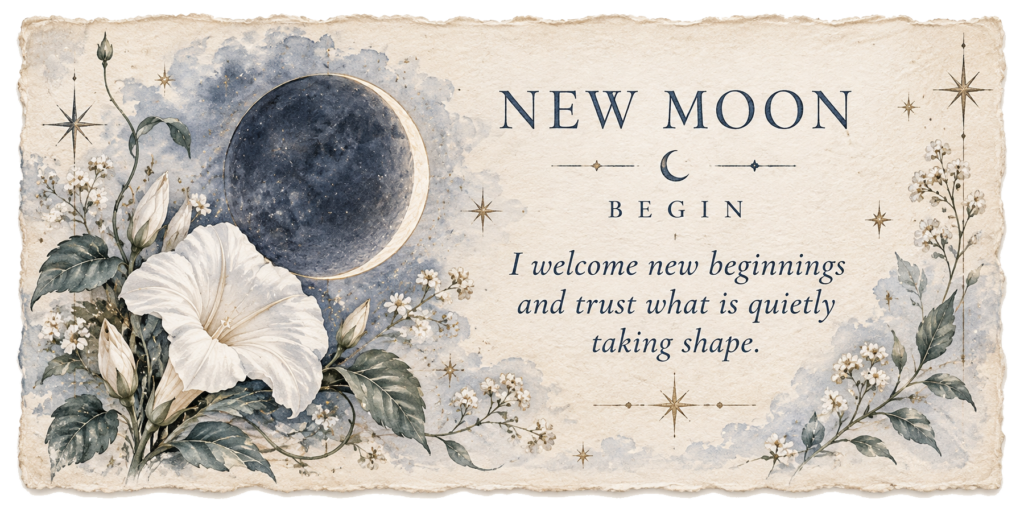
The New Moon occurs when the Moon is positioned roughly between Earth and the Sun, with its illuminated side facing mostly away from us. From Earth, the Moon seems to disappear into the darkness.
I love the symbolism of that.
There is something beautiful about beginning when there is almost nothing yet to see. The New Moon reminds me that an idea doesn’t have to be completely formed before I can begin moving toward it.
My Simple New Moon Practice
I find a quiet moment and think about what I genuinely want to move toward. Sometimes I write it down; sometimes I simply sit with the thought.
A celestial journal can make this practice feel a little more special, and I often love incorporating a moonstone or scent as well—but none of these things are necessary. The intention itself is what matters to me.
One question I like for the New Moon: What would I like to begin?
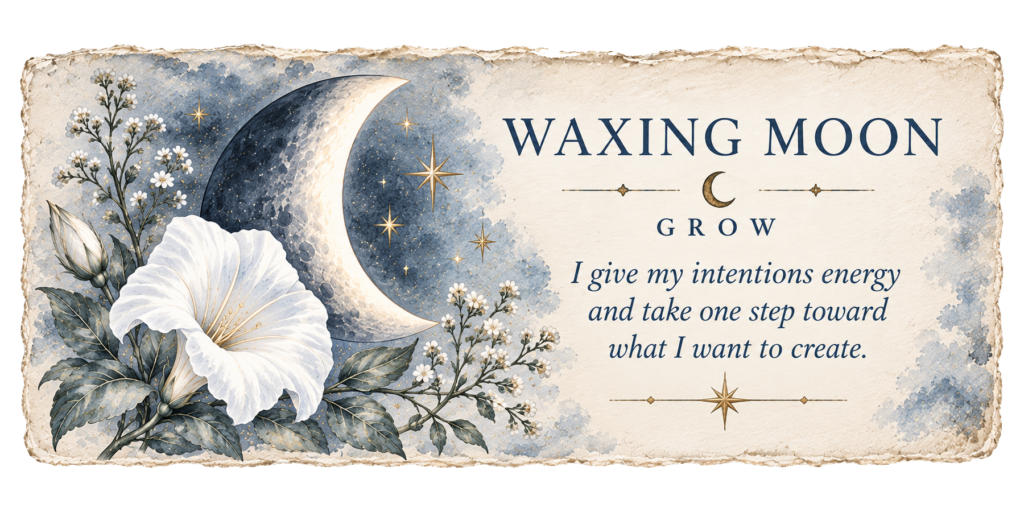
The Waxing Moon — Growing What You’ve Started
After the New Moon, a thin crescent gradually appears and grows night after night.
I associate the waxing Moon with movement, growth and momentum.
This is where intention begins to meet action.
I think this part can sometimes get lost when we talk about manifestation. Writing down what we want can be meaningful, but eventually we also have to participate in creating it.
During the waxing Moon, I like to return to whatever I thought about at the New Moon and ask myself whether I am actually doing anything to move toward it.
It doesn’t need to be dramatic. One email, one conversation, one new habit or one small decision can be enough.
My Simple Waxing Moon Practice
I choose one practical step connected to something I want to grow.
Then I try to actually do it.
If I want a physical reminder of that intention, I might keep a green aventurine or citrine palm stone nearby while I’m working or place it somewhere I will notice it during the day.
One question I like for the waxing Moon: What can I do today to help this intention grow?
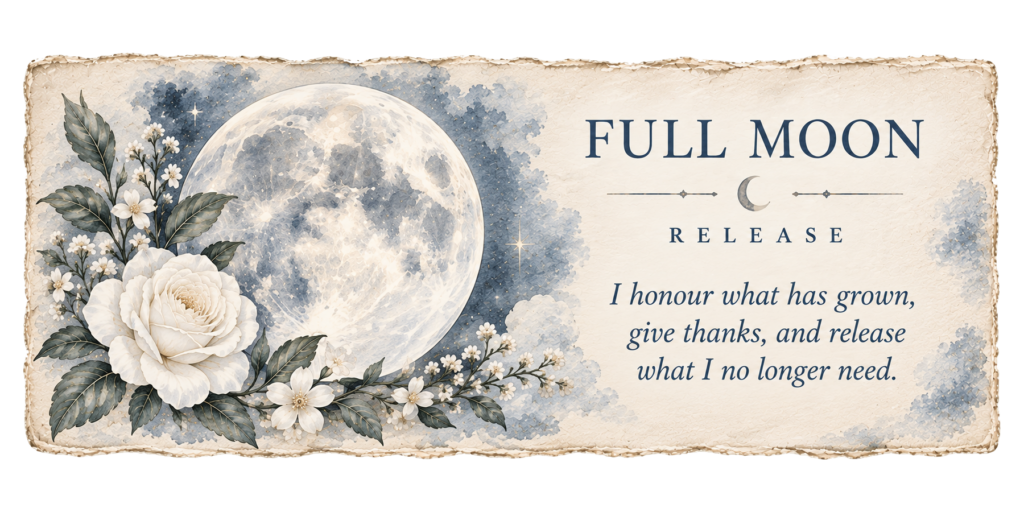
The Full Moon — Illumination & Release
There is something completely different about a Full Moon.
Even when I’m not intentionally following the lunar calendar, a beautiful Full Moon has a way of making me stop and look.
Symbolically, I think of the Full Moon as the point when things are illuminated. Something that began quietly at the New Moon has reached fullness, and it becomes a natural moment to look at what has changed.
What worked? What didn’t? What am I grateful for? And is there something I no longer need to carry with me?
For me, Full Moon energy isn’t only about releasing negative things. It can also be about recognizing what has grown.
I think gratitude belongs here just as much as letting go.
My Simple Full Moon Practice
I like to go outside if I can and simply spend a little time beneath the Moon.
Sometimes I journal. Sometimes I think about something I am ready to release. Sometimes I make Moon water. And sometimes I do absolutely nothing except look at the Moon.
That counts too.
If I am using crystals, this is also a time when I enjoy bringing them into my practice. Moonstone and selenite especially feel naturally at home in this part of my lunar routine.
One question I like for the Full Moon: What can I appreciate—and what am I ready to let go of?
Making Moon Water
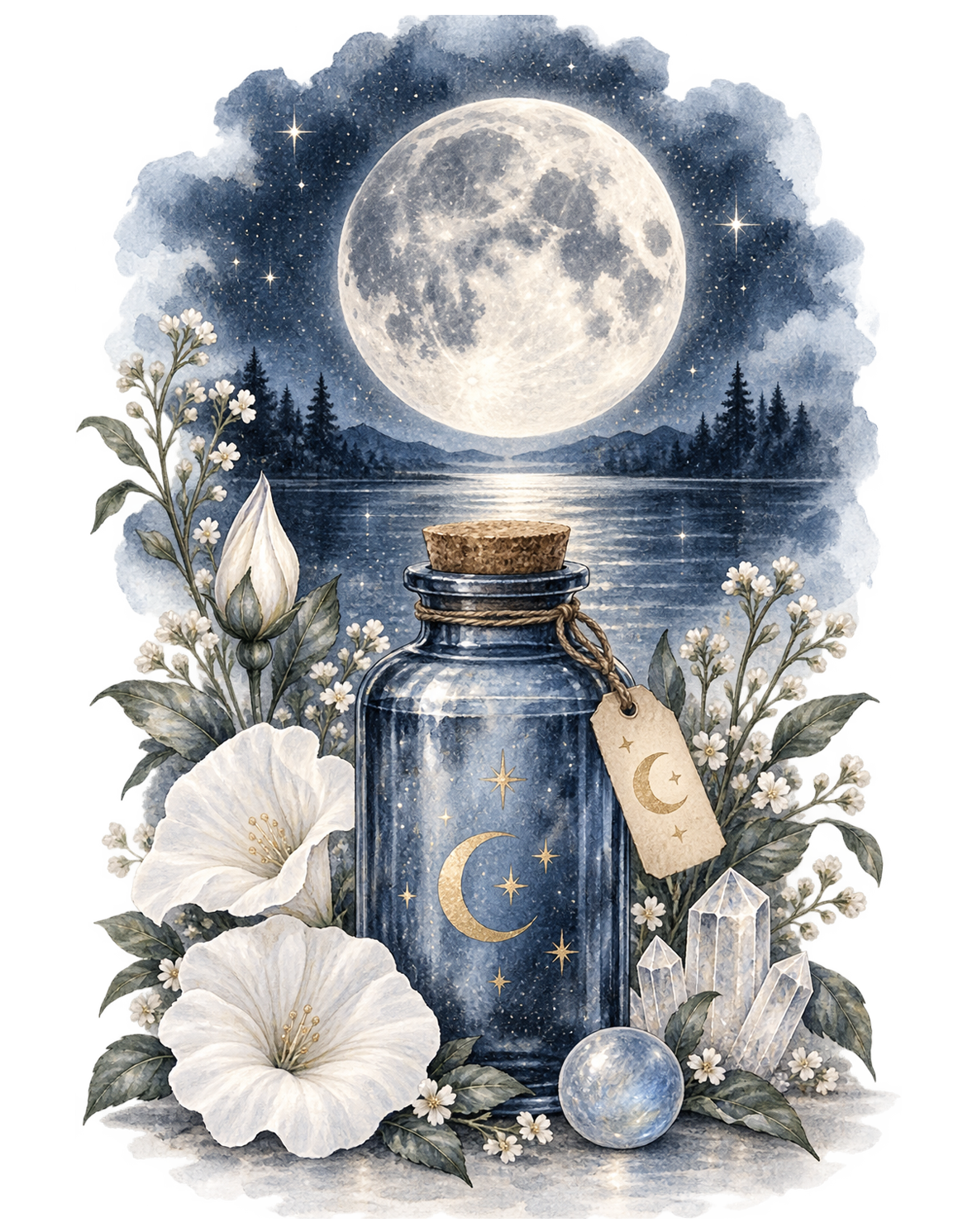
Moon water is probably one of the simplest Moon practices, and perhaps that is why I like it so much.
At its most basic, it is simply water intentionally left beneath the night sky, usually around the Full Moon. The spiritual meaning comes from the intention we give it rather than from the water physically absorbing a special lunar substance.
I usually prefer simple practices like this because they don’t require a collection of special tools.
How I Make Moon Water
I fill a clean glass jar or bottle with water, cover it securely and place it somewhere where it can sit beneath the night sky—outside when practical, or near a window.
Before leaving it, I take a moment to think about what I want the water to represent. It might be clarity, peace, gratitude, renewal or connection with the Moon.
In the morning, I bring it back inside.
I may use Moon water to water plants, add some to a bath or use it symbolically while journaling.
If I intend to drink it, I treat it exactly as I would ordinary drinking water
A Note About Crystals and Moon Water
I prefer keeping crystals beside the container rather than dropping them into drinking water.
Not every mineral is safe to immerse in water, and some can be damaged by it. Keeping the crystal outside the jar gives me the symbolism I want without making things unnecessarily complicated.
A moonstone, clear quartz or selenite charging plate placed nearby is more than enough for me.
The Waning Moon — Clearing & Letting Go
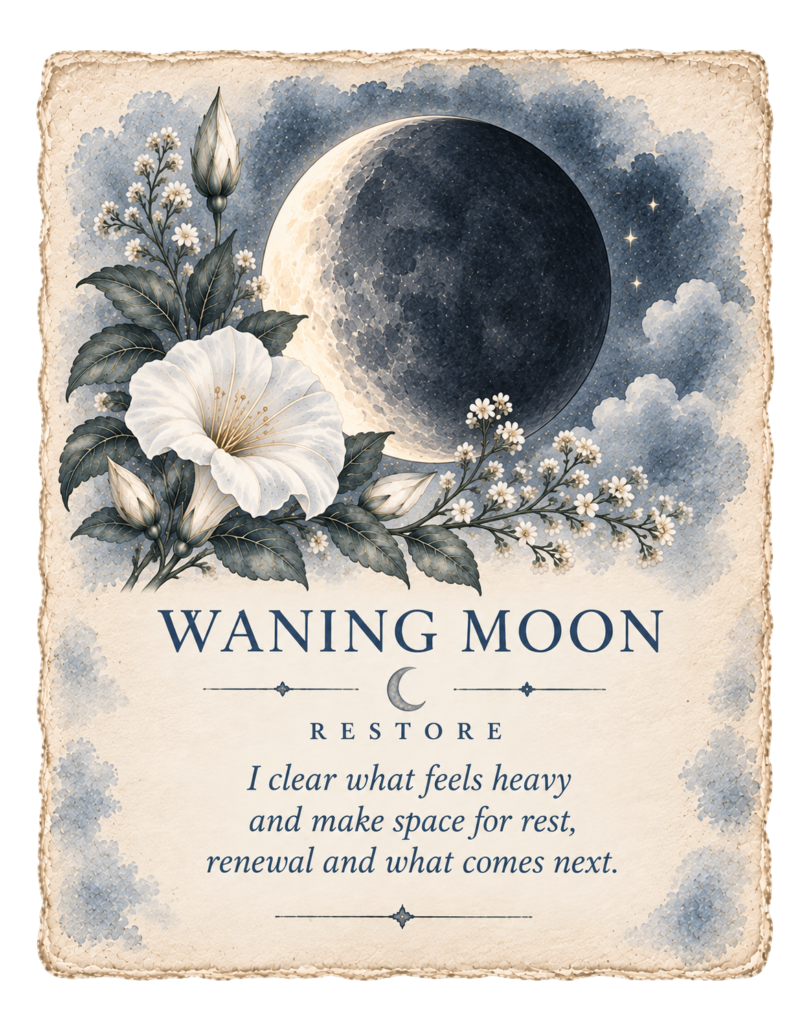
After the Full Moon, the visible light gradually begins to decrease.
I think of this as the quieter half of the lunar cycle.
If the waxing Moon is about adding, building and moving forward, the waning Moon reminds me that there also needs to be space for removing, finishing and resting.
I find this especially meaningful because I naturally tend to think about what else I need to do. There is always another project, another idea, another thing that needs attention.
The waning Moon reminds me that progress doesn’t always mean adding more.
Sometimes progress is deciding what I don’t need anymore.
My Simple Waning Moon Practice
I choose something to clear.
It might be a physical space, an unfinished task, an old habit or simply something that has been taking up too much mental space.
Sometimes I’ll burn incense in my Moon and Stars incense holder while I’m cleaning or journaling because scent makes even a very ordinary moment feel more intentional.
One question I like for the waning Moon: What can I release to make more space in my life?
Lunar Eclipses — Moments of Change
A lunar eclipse is not simply another phase of the Moon.
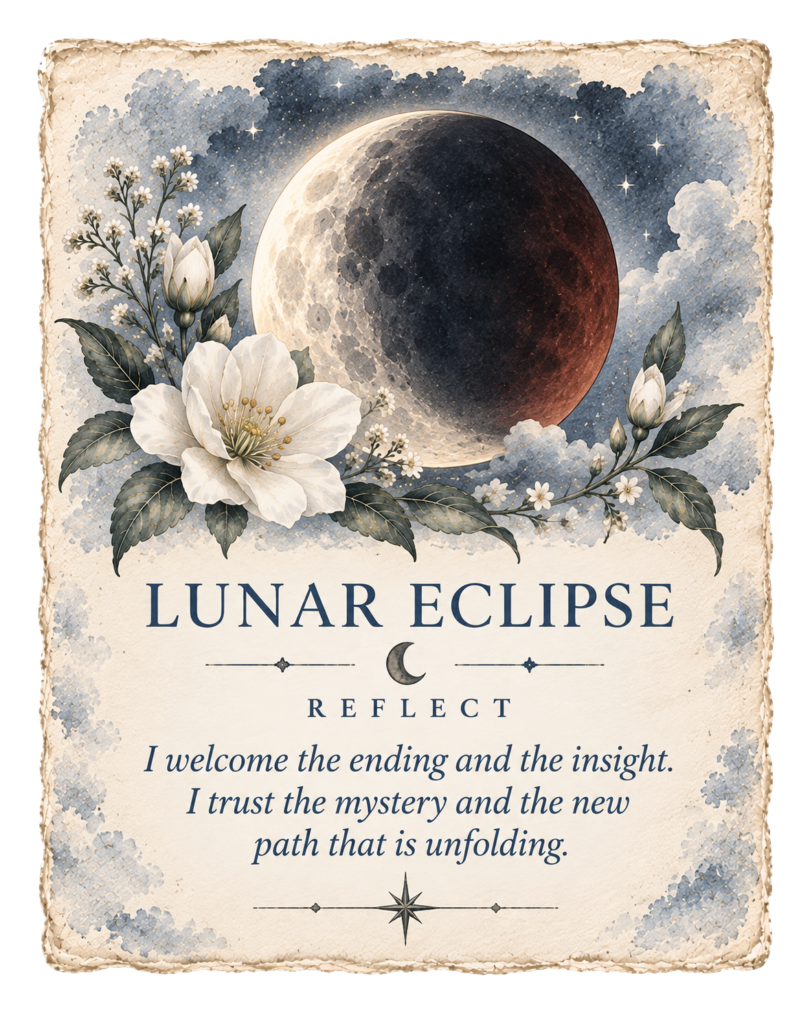
It occurs when Earth passes between the Sun and the Full Moon and Earth’s shadow falls across the lunar surface. During a total lunar eclipse, the Moon can take on that extraordinary reddish colour that gave rise to the name Blood Moon.
Eclipses have carried powerful symbolism in many cultures throughout history, although those meanings vary enormously.
In my own spiritual practice, I don’t treat an eclipse as something to fear.
But I do treat it differently.
The regular lunar cycle feels rhythmic and familiar to me. An eclipse feels more like an interruption—a moment that encourages me to stop, observe and pay attention.
I associate it with change, revelation, endings and seeing something differently.
My Simple Lunar Eclipse Practice
I keep eclipse practices very quiet.
I might journal, meditate, spend time outside or simply think about what has been changing in my life.
Unlike the New Moon, I don’t feel a need to make a long list of intentions or try to manifest something during an eclipse. For me, it is more interesting to observe.
Sometimes the most meaningful spiritual practice is simply paying attention.
I might keep my celestial journal and an amethyst palm stone nearby and write down whatever comes to mind.
One question I like for a lunar eclipse: What is this moment asking me to see differently?
Crystals and the Moon
Crystals are one of my favourite ways to add a physical element to spiritual practices.
I don’t believe I need a different crystal for every Moon phase or every intention. Often I simply choose one that feels appropriate for what I am focusing on.
For lunar practices, I especially love moonstone because of its traditional association with intuition and lunar symbolism. Selenite has a beautiful pale, almost moonlike appearance, while clear quartz is wonderfully versatile.
Amethyst can feel appropriate when I want my practice to be more reflective, while rose quartz brings a softer element when my intention involves love or self-compassion.
Rather than collecting everything at once, I prefer slowly choosing pieces that I genuinely like and will actually use.
Essential Oils and Lunar Practices
Scent is another simple way I like to create atmosphere.
For quieter Moon practices, I naturally gravitate toward softer scents such as lavender essential oil, Roman chamomile essential oil, sandalwood essential oil, jasmine essential oil and neroli essential oil.
I don’t think there needs to be a rigid rule saying a particular Moon phase requires a particular oil.
For me, scent is more personal than that.
Sometimes lavender feels right because I want calm. Sometimes neroli makes an ordinary evening feel beautiful and special. Sometimes I don’t use anything at all.
When I do use essential oils, I use them appropriately diluted or in a diffuser rather than applying undiluted oils directly to my skin.
Monday, the Moon and the Planetary Days
The Moon doesn’t only appear in the lunar cycle traditions I love exploring.
Monday itself has traditionally been associated with the Moon. Even the English word Monday ultimately comes from the idea of the “Moon’s day.”
That connection is one of the reasons I like treating Monday as a gentler beginning to the week—a day for intuition, emotions and checking in with myself before everything starts moving too quickly.
I’ve written an entire guide to living in rhythm with the cosmos and the seven planetary days, including their traditional planets, crystals, colours, flowers, essential oils and simple practices.
The Moon, the Stars and Our Place in the Cosmos
One of the things I love most about looking at the Moon is that eventually my eyes wander beyond it.
To the stars.
There is something humbling about remembering how small our everyday worries are beneath a night sky that stretches unimaginably far beyond us.
My interest in the Moon is part of a much broader fascination with our relationship with the cosmos—both the physical universe we can observe and the spiritual ideas humans have created around it.
That curiosity is also what drew me toward exploring Starseeds and our spiritual connection with the stars.
Whether you interpret these ideas literally, symbolically or simply enjoy exploring them, I find the stories fascinating.
You Don’t Need a Perfect Moon Ritual
This may actually be the most important part of this entire post.
You don’t need twenty crystals.
You don’t need an elaborate altar.
You don’t need to perform the perfect Full Moon ritual every month.
And you certainly haven’t “missed” something because you forgot the New Moon happened until the following morning.
For me, living in rhythm with the Moon is much simpler.
It is noticing.
Looking up.
Remembering that life moves in cycles.
Knowing there are times to begin, times to work toward something, times to celebrate what has grown and times to let something go.
Some months I may journal, make Moon water and choose a crystal.
Other months I may simply step outside, look at the Moon for a few minutes and think about where I am in my own life.
Both are meaningful to me.
The Moon doesn’t ask us to keep up with it.
It simply keeps moving through its cycle—and reminds us that we can too.
My Favourite Tools for Moon Practices
If you enjoy adding crystals, incense, journals or essential oils to your own Moon practices, I’ve collected some of the things I personally like and use as inspiration in my Marina’s Garden collections.
purchases. If you purchase through one of my links, I may earn a small commission at no additional cost to you.
Continue Exploring the Cosmos
If you’d like to continue exploring these ideas, you may also enjoy Live in Rhythm with the Cosmos: The Seven Planetary Days, where I explore the traditional celestial associations of Monday through Sunday.
You can also read my post about Starseeds and our connection with the stars and the different star systems associated with Starseed traditions.
And once we revive it, add Crystals for Each Day of the Week here as the third related article.
